
Story v. Reality (repost)
A reflection on being robbed at gunpoint outside my Nashville apartment, my fictionalized retelling of it, and the attitude of the police tasked with protecting me.

( Hey gang! This personal essay was originally written and posted in November of 2022. It was removed not long after, but I do feel proud of it, so I’m putting it back up. We’ll get back to lighter and shorter stuff in my next post. Thanks so much for reading and subscribing!)
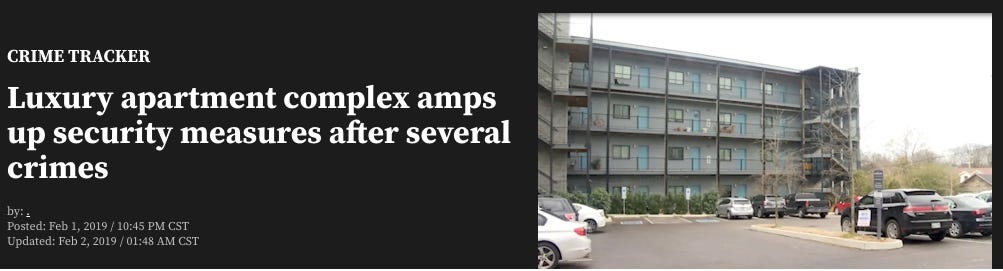
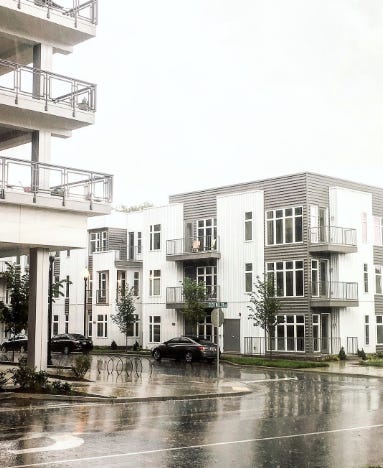
In the last few years, I haven’t been interested in writing memoir. As much as I love reading it, when it came to my own life I preferred taking a fictional route — usually using my experiences as a jumping off point and spinning things as I like — whatever best serves the story. My first fiction publication (Fish in Hiding) came about that way: I was mugged, at gunpoint, in the parking lot of my apartment complex.
The experience is a pillar in my memories — a before and after moment — though on some days I like to douse it in a fog of the mundane. I live in a city. It was bound to happen at some point, and I came out unscathed. Life goes on. But all it takes is bringing up the fact with my friends and family to be reminded of its towering, irritating presence in my psyche.
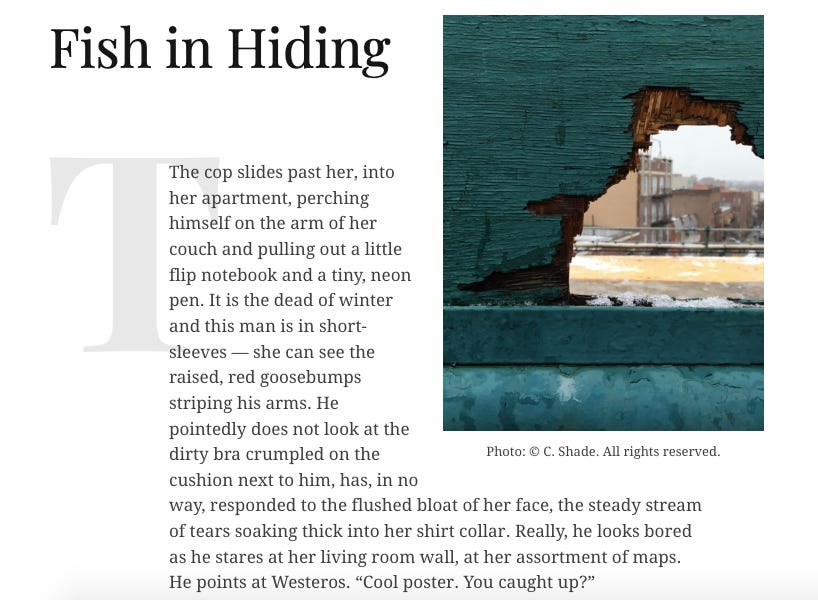
In the story, a woman who lives alone is mugged, at gunpoint, outside of her apartment, and develops an absolute terror at the prospect of leaving her home after dark. I developed this terror, but I did not live alone. I can’t remember, writing, at this moment, if the mugging happened just before or just after I got married. I just remember that I did have my engagement ring, and felt a rush of relief when I realized, in the aftermath, that the mugger did not notice the ring and insist I hand it over, as he did with my bag and my phone. The ring, my husband would remind me, was not all that expensive — we had chosen it together, from an Etsy shop — and we could have, would have, replaced it.
But there were irreplaceable things that were lost that night.
I was coming home from a novel writing workshop. In my bag was my laptop, filled with writing, notes, photos, games, most of it completely lost after this night (who among us has not realized their lack of backing things up too little too late? Try not to judge me.) There was also my notebook of handwritten scenes and outlines, printed edits tucked into its pages, all entirely lost, dumped into a trash somewhere, surely.
It would be weeks after the mugging that I finally built up the courage to go through my backed-up files to see what I could salvage of my novel, short stories, and essays. Not all is lost, but so much is that I don’t work on the novel again for months, a year.
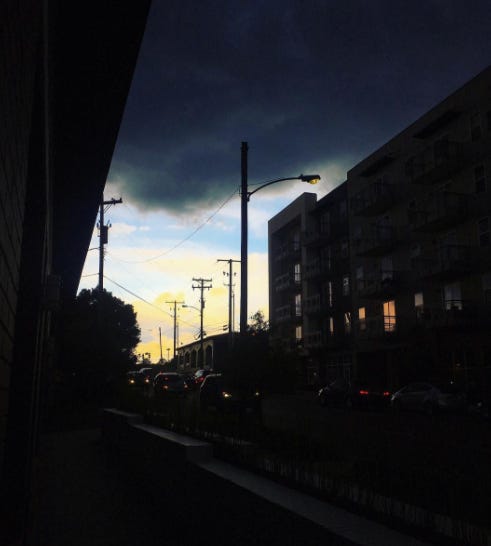
When the mugger, gesturing with the nose of the gun, told me to go, I ran straight to my apartment, where my husband was watching TV with our cats, the heat running high, because outside it was at least 5 below freezing, an unbelievably cold night for Tennessee. He answered the door with a grin, not understanding why I didn’t just unlock it myself. “You cold?” He asked, laughing, but quickly his face dropped in reflection with mine.
Within minutes of the mugger releasing me, my husband is on the phone with a 911 operator. He explains what I was able to tell him. That there is a man with a gun still out there, and that many other people live here. It’s not all that late and there will be more people arriving home. Please hurry.
By the time the police arrive, the mugger has attacked someone else, made them lay on their stomach on the pavement while he picked everything from their pockets and prodded their back with the gun. He then escaped in a waiting car.
I’m being unduly fair to the officer who came to my apartment that night by saying that he seemed only mildly interested in the situation. He makes awkward comments about the posters on our walls and asks, with little affection, “you alright?” before beginning a cold and short interview. Most of the questions involve the material worth of the things stolen from me, and not the violence of the situation.
He asks me to describe the mugger, and I do the best I can, but in truth I am able to more accurately describe the gun, because it is what I stared at — a large handgun with a decorated handle and a slender nose, an unsteady hand gripping it, bobbing it around with its aim at my stomach, then my chest, then my pelvis, then my stomach again.
The officer, after some time spent on the radio, tells my husband and I that they’ve pulled over a couple of men who may be the suspects. They ask me to come with them to identify the men, and I do.
We drive much further outside the city than I expect, pull into a parking lot where there is a mess of police surrounding one small sports car. The officer driving tells me that I will not leave the car, that they’ll shine a light on the men from where I’m at and see if I recognize either of them.
This night is blurred in many places, my senses shot, memories surfacing only occasionally, but I remember clearly leaning against the window to see the men, handcuffed and held roughly by the officers. They shine the flashlights into the men’s faces and they squint and grimace, but the light is unnecessary. Even without it, from dozens of feet away and inside a car, I can see that neither of these men look anything like the man who mugged me.
The hair and clothes don’t match. The only similarity I can see is that they are Black men and the man who mugged me was also Black, though even the skin of the man who mugged me was described as lighter, his hair short. These men were much darker, with long braids, in clothes newer and more fashionable than the mismatched, oversized wardrobe the man who mugged me was in.
When I tell the officer that neither of them look like the man at all, he asks if I’m sure, and mentions that they were “speeding away from the city”, as if speeding in a certain direction is any sort of indicator of guilt, and not just a common way men in sports cars drive on the interstate. I tell him I’m certain, and he takes me home, letting me know that a detective will handle my case now, and that I should get a call sometime the next day.
Before leaving us in the parking lot outside our home, the officer tells me that they took the other victim to identify the men, and he gave the same response I did. That they looked nothing like the suspect.
I spend the night trying to sleep, still reeling from the terror of the evening, and also seeing those two men’s faces, pained in the harsh shot of light. Did they have guns pointed at them that night too?
I think this is it — why I’ve gravitated to fiction — the point in the story where reality defies narrative. The ending of my short story is open-ended, too, yes. The woman does not conquer her fear of going out at night, exactly. She ventures into the night, but caves to her fear and inflicts violence on an innocent stranger, before running home again. She’s so paralyzed by her fear of crossing the site of her mugging that she pisses herself in her car.
Neither of these things happened to me. I was not alone. My husband helped me get back into therapy, where I worked through my PTSD. I did not, as my character did, pull a knife on a stranger who had startled me, but I did look into the eyes of two Black men who had not hurt me, who had nothing to do with me, as they were harassed by mostly white police officers, tasked in this moment with protecting me.
The character in my story gets a hopeful last line, a chance at a blossoming love, or at least just a safe space, a new friendship. In real life these instances are just threads in a large, complicated tapestry. I think of those men at every instance of police brutality in the news. I think of how cold the officer was with me, how little he seemed to care about me, until it was time to arrest and punish someone.
I think of how often it was theorized to me that the gun used in my mugging was fake, since it was never fired, as if we haven’t been reminded, over and over, how easy it is to get a gun. They sell them at flea markets here, out of the backs of pickup trucks. Even if you don’t seek them out, family members will try to pass them down to you, as if they’re some sacred heirloom and not an omen, a shining tribute to bodies torn apart.
Months after the mugging, the gunman’s face would surface from one of my social media feeds — a mugshot leaping out at me from a bed of selfies and memes. He was arrested for a crime I won’t describe in detail, because maybe I’m wrong. I want to trust the intuitive flare that twists my stomach when I see his face again, but we know that this isn’t reliable, that memories around a traumatic event can be skewed, and, in reality, victims aren’t good at identifying perpetrators. I will just say that harm was done to a child — deep, lifelong harm — and I think about them, and how we all failed in protecting them. How they’re going to be mitigating the hurt from that night for their whole life.
And I think about him, the gunman.
His story was published after his arrest — I will, once more, not disclose details, in case I am mistaken — except to say that his world had come crumbling down in a way that I have never, will never, experience. He was alone. Not a fictionalized character alone. He was alone, in this reality, in this city. He was ill. He was lost. He became violent, and now he’s in prison, where people, once in, are almost guaranteed to return, again and again, for the remainder of their lives.
A community that cares for its most vulnerable would have helped him when his life came crashing down, before he mugged me and long before he hurt that child. But no one noticed, or at least no one cared, and he became our nightmares, someone mentally ill and coming down from drugs, with a deadly weapon, no reason to live, and nothing to fear.
Luckily there are a lot of people, people a hell of a lot smarter than I am, doing The Work, and I’m going to end this by highlighting a few of them. Trusting people and organizations like these to lead the way in our city is the only way that we can not just protect ourselves and our neighbors, but address the needs of our most vulnerable people, people like him, and like the child he hurt, who I would do anything to go back in time and guard, like a doberman, but I can’t, because there is no going back. There is just going forward.
The Metro Nashville Community Oversight Board
Nashville People’s Budget Coalition